Gold for the Paris 2024 and Reelevant collaboration!
Discover the collaboration between Paris 2024 and Reelevant, which won over the jury of the 2025 Trophée Marketing B2C Awards and took the Gold Medal!


Product Marketing Manager

Up to six times the initial investment, +38% average order value, two weeks of production cut to two hours: that's what RCS changes when it carries personalized content.
On October 19, at Google Paris, Sinch and Reelevant brought together some fifty CRM experts from retail, premium brands, travel, automotive, banking and insurance, with one rule: talk conversion and ROI, not click-through rates. On the agenda: Google's view of the market, Sinch's and Reelevant's vision, first-hand insights from Clarins and Printemps, then three roundtables on loyalty and retention, driving a second purchase from one-time buyers, and reconnecting with inactive customers. Everyone reached the same conclusion: RCS opens a door email no longer gets through, but it only creates value if it carries content designed for each customer and is part of the whole relationship.
RCS is no longer a promise. With 87.7% of smartphones compatible, 53 million active mobile users and more than 2,000 brands sending messages this year, France is one of the most mature markets in the world. The turning point was RCS arriving on iOS about two years ago: brands can now reach their entire SMS opt-in base without starting from scratch.
Laura Restier (Google) summed up consumer expectations in three words: trust, personalization and recognition. RCS checks the first box with a carrier-verified sender, name and logo included, where an SMS raises suspicion. Everything else happens in the native messaging app, with nothing to download: rich cards, carousels, suggested replies, videos, documents.
Sinch has operated RCS since 2019. Its takeaway from seven years of A/B testing: RCS consistently performs two to four times better than SMS. And it isn't just for peak sales moments. It supports product discovery, conversion, customer service and loyalty program sign-ups. Marie (Sinch) walked through the proof.
Conversation goes even further. Connected to the product feed brands already have, Sinch's conversational assistants only suggest items in stock. At Courir, a shopper searches for women's sneakers in size 39, gets a selection of available pairs and adds one to the cart without leaving the messaging app. As for WhatsApp, it doesn't compete with RCS: it nurtures a community of top customers, while RCS drives business across the entire opt-in base. Sinch's advice: if you tested RCS before it came to iOS, test it again.
For years, technology forced brands to think in segments. But customers don't experience a brand through its campaigns, segments or channels. They experience it through the content they receive. That's the starting point of content-first personalization, presented by Sonia (Reelevant).
In practice, the Reelevant engine connects to the data and tools the brand already owns: BI, scoring, segmentation, and platforms like Sinch. For each customer, at the moment of interaction, it composes content from several components: products viewed or purchased, stock at their store, their loyalty offer, the final discounted price, even the weather. That same content stays consistent across email, app and RCS, at the scale of millions of customers, multiple brands and multiple countries. RCS only makes an impact as part of this overall strategy. In the end, the only channel is the customer.
At Clarins, RCS campaigns grew 462% between 2025 and 2026. Victoria Bertrand and Fanny Marbeuf (Clarins CRM team) traced the journey: a first test in 2022 held back by the lack of iOS, a relaunch in 2024, then rapid acceleration.
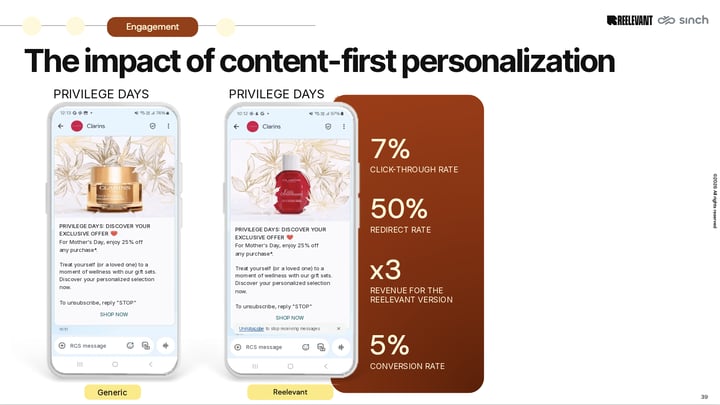
The standout number: during the Journées Privilèges event, 44% of customers who received the personalized version generated 70% of the event's revenue. The move to RCS was fast because Clarins reused the logic already running on email, where 100% of newsletters are personalized in real time and personalized blocks get three times more engagement.
The brand's compass is predictive CLV, which adjusts products, offers and level of generosity to each customer's future value. Next step: tailoring not just the product but the argument, depending on whether a customer responds to price, reviews or visible results. Then a fully individualized birthday journey, by email or RCS depending on each customer's preferred channel. As Victoria Bertrand put it, the goal is "to move from personalizing content to personalizing the customer relationship."
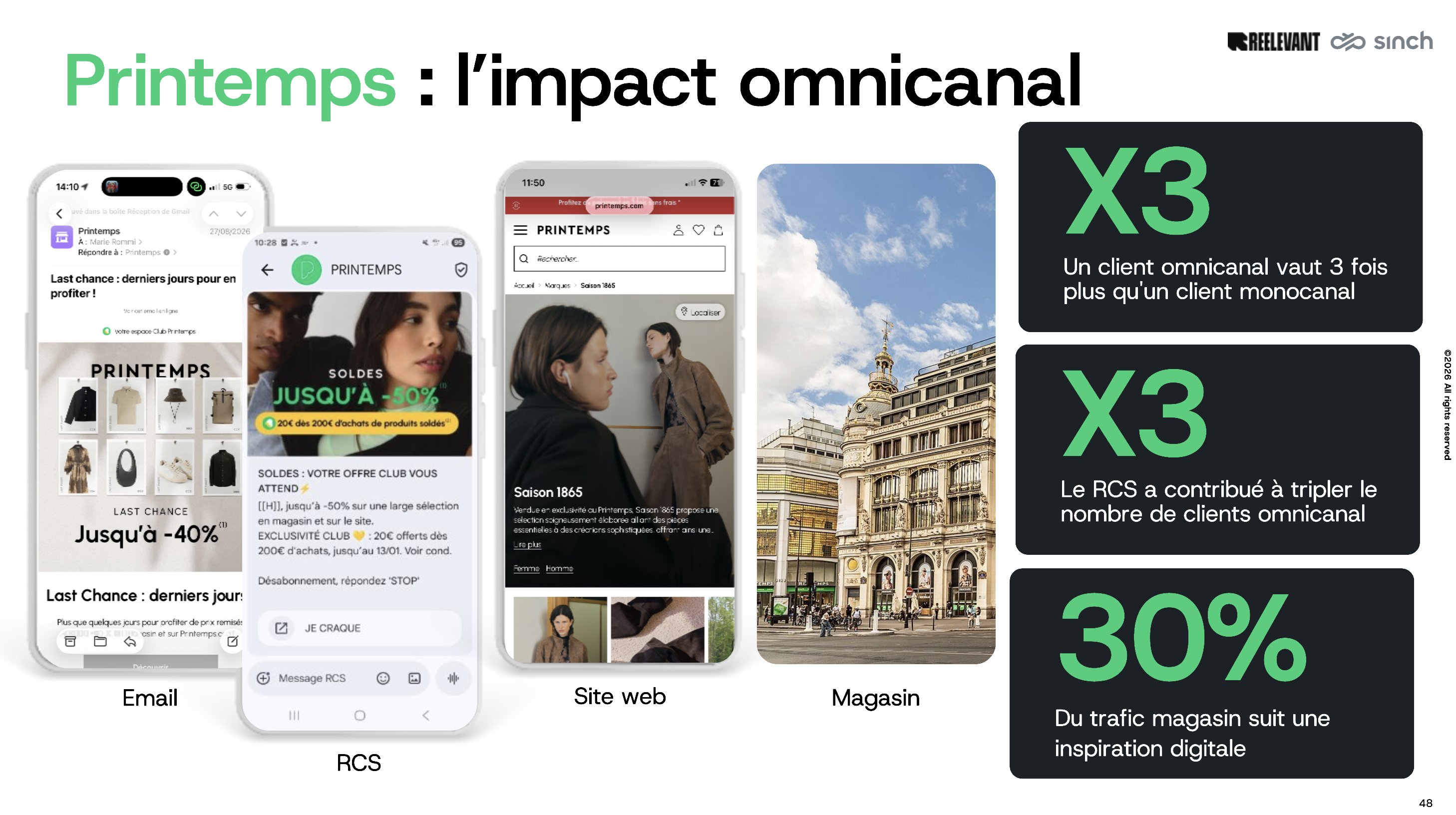
With RCS, Printemps tripled its number of omnichannel customers. Since they're worth three times more than single-channel customers, the case makes itself.
First tested in 2022 on Android only, barely 20% of its customer base, RCS took off with iOS: on promotional offers, it gets 10 to 15 times more customer responses than SMS. Each channel now has its role: SMS for information, Rich SMS for trade marketing, RCS for offers and flagship events, WhatsApp for top customers. And RCS is built into the journey: the day after a launch email, high-value customers who didn't open it receive an RCS message.
The challenge for Sikou Diaby (CRM Manager, Printemps): personalizing abundance, with hundreds of brands, 13 stores and assortments that vary from one store to the next. Printemps feeds its lifestyle segmentation and predictive brand-affinity score into Reelevant. Our engine then refines down to the individual, using browsing, home store, available stock and loyalty status. The goal: reassure with familiar brands and introduce new ones. On the same message sent to 150,000 contacts, the personalized version beat generic RCS by 18 points of conversion rate. The gain is operational too: a conversational RCS that took two weeks to build by hand now takes two hours.
Both brands give the same advice: dare to test, measure against a control group, and start from the customer, not the channel. That's exactly what the three roundtables put to the test.
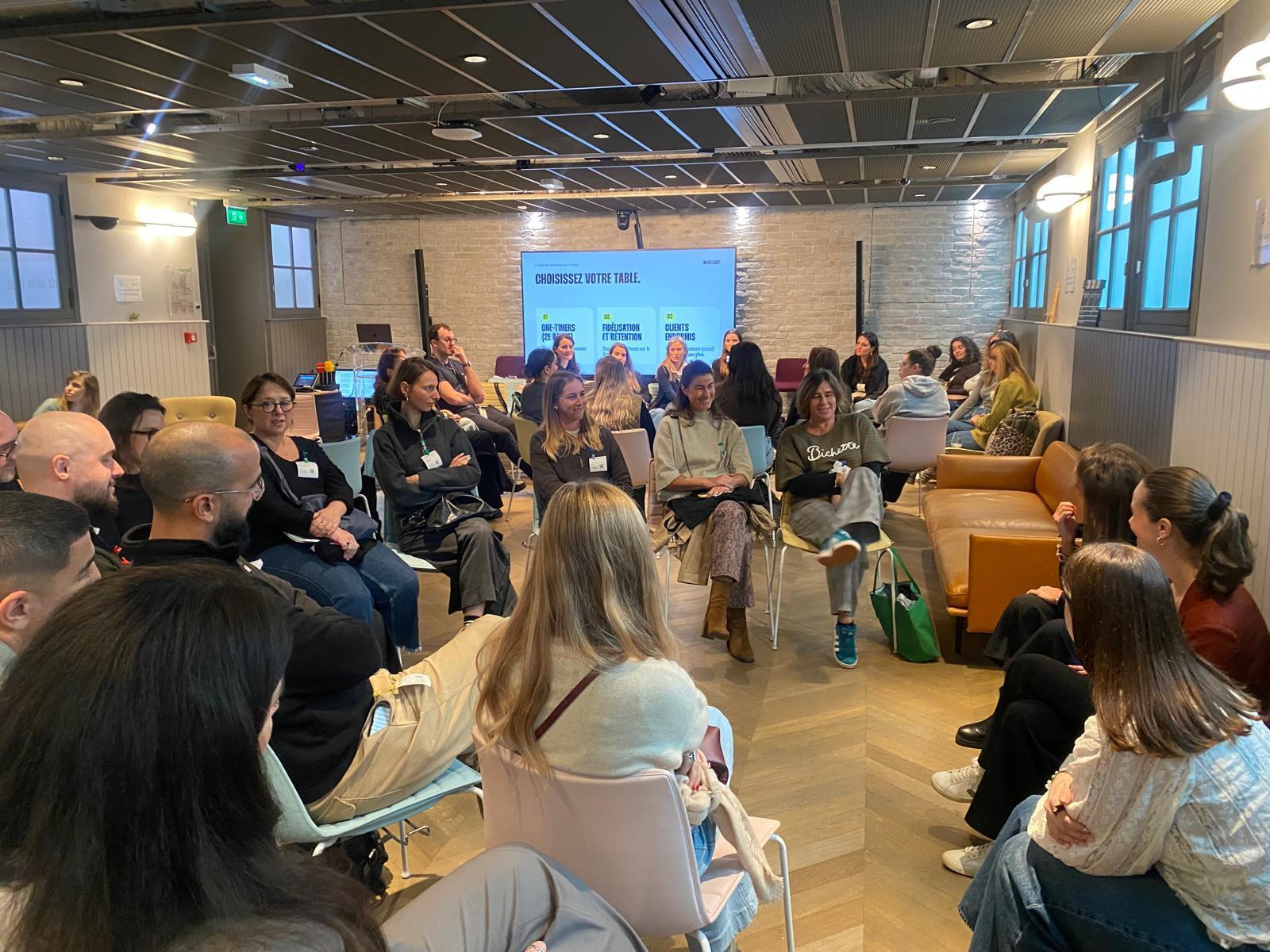
With or without a loyalty program, the question is the same: how do you stay connected with customers between purchases? The mechanics exist, from tiers to birthday offers to lifecycle journeys. What's missing are moments customers actually experience. For several participants, email still carries up to 85% of all communications, phone numbers get lost at checkout, and the app is deleted from the phone after the vacation.
The table sketched out three answers. First, capture contact details at the right moment: a QR code at checkout that opens an RCS conversation collects a valid number, consent and a first reason to come back, all in one step. Next, get customers talking: a "What's changed in your life?" carousel updates the data and triggers the right journey, from a new baby to a move. Finally, make the benefit tangible, with an expiring offer or points, the customer's own products and a countdown.
Then there's trust. The verified sender badge is still little known: some customers show the message in store instead of clicking. In regulated industries, a short video when the conversation opens makes all the difference.
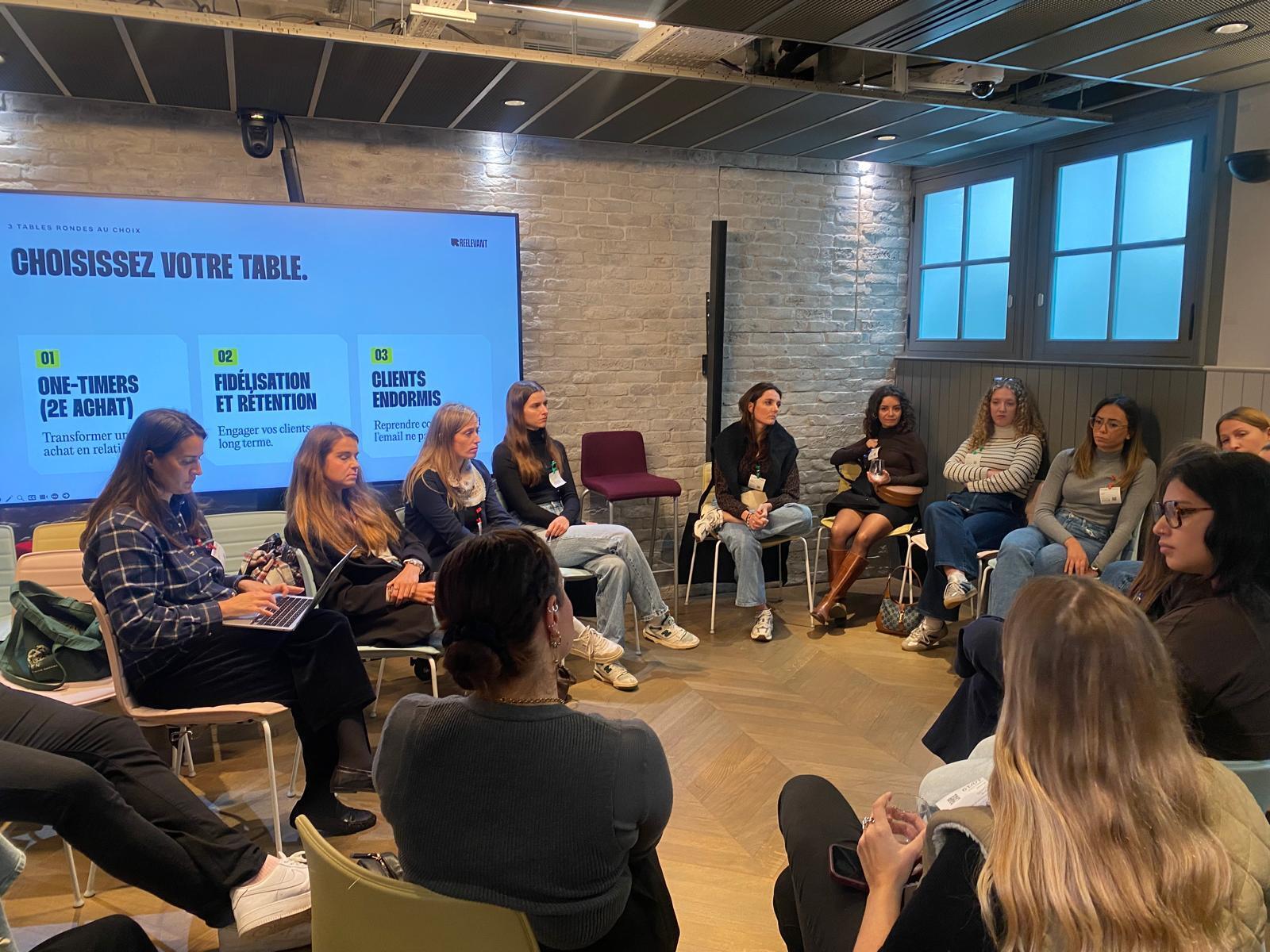
Vouchers, coupons calibrated to average order value, welcome journeys: every brand has tried to bring back its one-time buyers, and none is satisfied. One test made the point. Sent to all customers with the same offer, an RCS message performed much worse with new customers than with top ones. The channel wasn't the problem. The message was the same for everyone.
Hence three directions. Profile one-time buyers, because a first purchase is always usable data: a frequent site visitor and an impulse buyer shouldn't be re-engaged the same way. Replace discounts with relevance: complementary products, routines, services, with each carousel card carrying its own message. Finally, save generosity for those who need it, using a promo-sensitivity score and the best offer each customer is eligible for.
To judge the results, brands track second-purchase conversion, customer value and unsubscribes, every month, year to date.
Every database has customers who no longer engage with email. Before trying to wake them up, you need to know who is really drifting away. A single threshold ignores each customer's rhythm: a car buyer doesn't drift away like a beauty customer.
Above all, email is no longer the engagement channel for everyone. Mobile channels are growing fast among younger customers. One participant put a number on it: push accounts for 40% of their sends but 75% of their revenue. Before labeling a customer inactive, analyze content engagement by age group and channel to see where they still engage.
To reconnect, the table first suggests defining inactivity by clicks, over a window calculated for each customer based on purchase frequency and value. Instead of a single threshold, look at how long each value tier takes to drift away, and set a specific inactivity window for each, starting with top customers.
Here RCS acts as a relay, not a replacement: it reaches on mobile the customers email no longer reaches. It also helps reactivate opt-ins, since a customer re-engaged on RCS can be brought back to email. One limit to keep in mind: its open rate dropped from 80% to 55% in one year. RCS will have its inactive customers too.
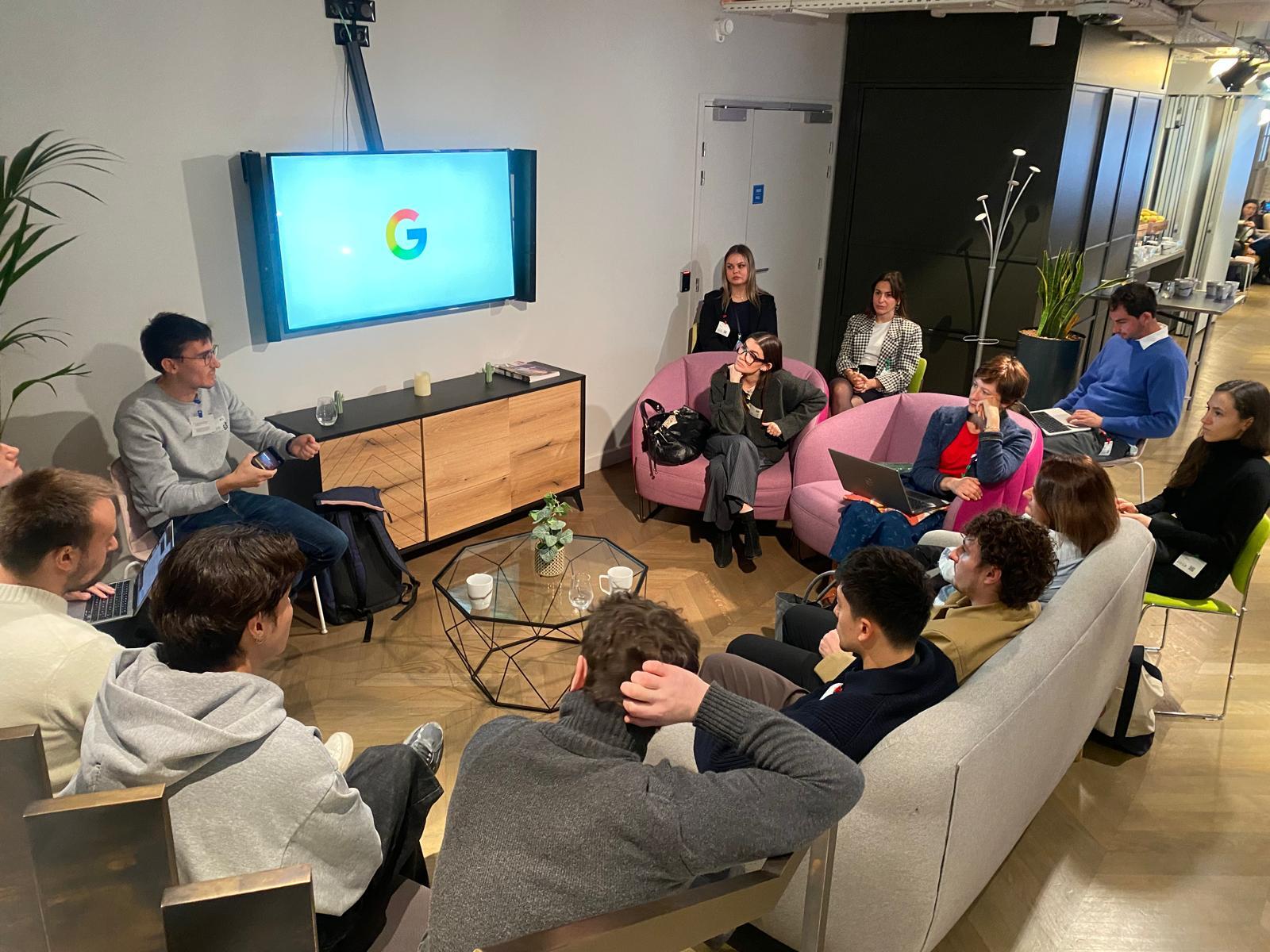
Four convictions came up throughout the morning. Performance comes from content, not the channel: with the same offer for everyone, RCS barely beats SMS. Personalization must be consistent from one channel to the next: an RCS message that doesn't share data with email and the app creates dissonance. Value is proven incrementally, against a control group, over a window aligned with the purchase cycle. Finally, a customer you can reach on several channels is worth more than a single-channel one: when one channel loses steam, another takes over. That's why collecting opt-ins from the very start of the relationship matters.
Until now, the brand has opened the conversation. Google is preparing the reverse: from search results, customers can already open an RCS conversation themselves, for free in organic results or through ads, still in pilot in France. Clarins activated it to welcome prospects: 73% clicked through to the website and 42% showed purchase intent from the very first results.
Over time, RCS will be able to support the entire journey, from discovery to loyalty, with the same conversational scenarios from one touchpoint to the next. The question will no longer be "which channel for which message?" but "how does each interaction strengthen the relationship?"
The safest path starts with a lifecycle moment that's slipping: a second purchase that never comes, a database going dormant, a program losing steam. Test a one-shot RCS there, personalized and measured against a control group, ideally during a peak moment like Black Friday or the holidays. Results come in within weeks, while a trigger takes longer to set up, and they give you the arguments to build what works into your omnichannel strategy.
The technical bar is low. You need a certified RCS agent, and Sinch helps you create it and get it approved by carriers and Google. Next comes a three-way scoping session with the brand, Sinch and Reelevant to define the carousel and the data that will compose each visual, followed by testing on real phones. You then schedule the send from your CRM, as easily as an SMS.
That's the whole point of the partnership. Sinch operates the RCS channel. Once the channel is tested and validated, Reelevant builds it into your customer lifecycle strategy with content-first personalization: our engine composes the content of each message at the moment of interaction, activating your existing stack, and measures its incremental value.
RCS isn't one more channel to feed. It's a new way to engage your customers, and it only delivers if each one gets a message that feels made for them.
So, which moment in your customers' lifecycle deserves its first RCS?
:

